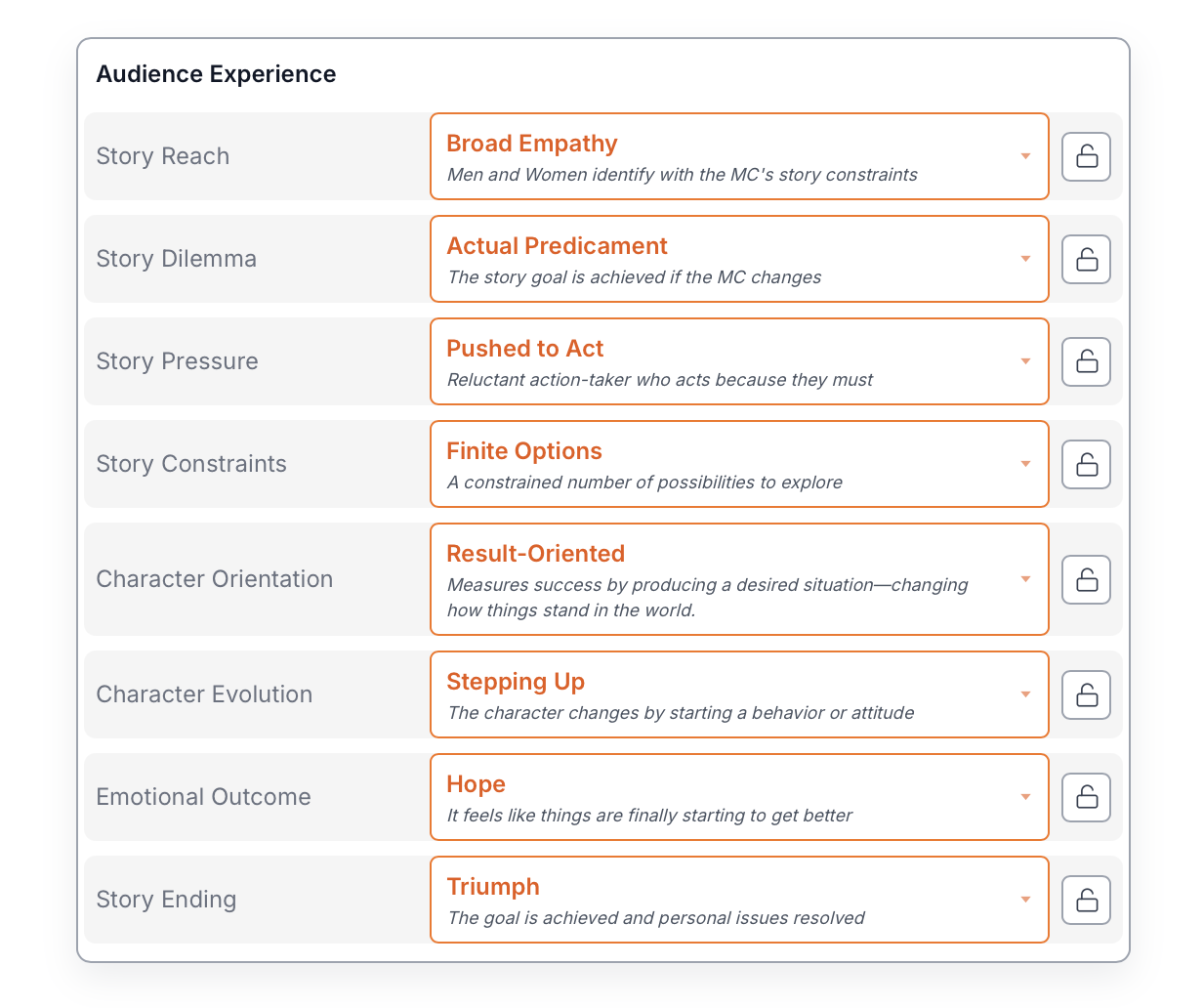
Working with Narrova, I’m pretty sure I (we) managed to figure out the storyform for Apollo 13! With all the illustrations we came up with, I’m pretty confident this is correct.
Note I did start out with two candidate storyforms, and this was one of them. But I was particularly impressed with how at certain points Narrova came to the same conclusion on elements as me, since I hadn’t shared my storyform with it. For example, when we got to Issues, Narrova went through and tested each quad against the story material, and each time came up with the same Issue I had! I can’t even usually do this – I often need to look at the Issues and Problem quads together to find potential fits.
Here is the storyform with illustrations (I asked for 1-2 bullet points for each storypoint, based on our discussion which did cover all these items). Need to split this in two due to post length.
Objective Story (OS) – Universe / Progress
| Storypoint | Choice | Illustration(s) |
|---|---|---|
| Domain | Universe (fixed situation) | Everyone is stuck in the external situation of a crippled spacecraft in deep space; they cannot simply “get off” or reset the mission. The whole world also watches from the fixed external state of “this may become NASA’s worst disaster.” |
| Concern | Progress | Conflict hinges on how things are going: CO₂ levels rising, power draining, temperature dropping, and trajectory/reentry angles constantly shifting for better or worse. Mission control obsessively tracks graphs and readouts charting the mission’s deterioration or stabilization. |
| Issue / CP | Threat / Security | The story continually foregrounds Threat—explosion, suffocation, freezing, missing the corridor, heat-shield failure—punctuated by Gene Kranz’s speeches about the dangers ahead. Security is the counterpoint: safe margins, conservative procedures, and jury‑rigged safeguards that try to keep the crew within survivable limits. |
| Problem | Expectation | Apollo 13 is treated as a routine mission expected to succeed, leading to complacency (no live TV coverage, everyone assumes “this one will go fine”); no one expects a tank stir to blow up the ship. Later, many expect the crew cannot possibly make it home, clashing with those who refuse to accept that outcome. |
| Solution | Determination | The OS resolves when NASA and the team embrace collective determination: “Failure is not an option,” “We’re going to bring them home.” Each new crisis is met by an unwavering resolve to find a configuration that works, culminating in the successful reentry. |
| Symptom | Hunch | People keep treating guesses, odds, and gut fears as problematic: Kranz warns against “guessing,” the president and media demand intuition-based odds, and the crew’s conspiracy hunch (“there are no reentry procedures”) eats at them. |
| Response | Theory | The system answers by insisting on structured, testable theories: engineers build models for power-up, reentry, and CO₂ solutions; Kranz demands they “work the problem,” and even Marilyn counters reporter hunches with her own “theory” that they can ask her husband themselves when he gets home. |
| Goal | Improve/Stabilize Conditions (Progress) | The objective effort is to arrest the deterioration of the crew’s conditions and bring them home safely: every action (power-downs, course corrections, jury-rig devices) serves to improve or stabilize the mission’s progress toward a safe splashdown. |
| Requirements | Present | To achieve the Goal, they must keep critical present conditions within safe ranges—CO₂ values, power levels, angles, etc.—and maintain everyone “on station” mentally and physically in Houston and in the spacecraft. |
| Preconditions | Learning | Before many solutions can work, people must learn new information or procedures: engineers have to understand the crippled system’s behavior, learn to make the “square peg” CO₂ filters work, and then teach the crew; Mattingly has to learn which power-up sequences are viable. |
| Costs | Doing | The price of success is “not doing” the mission as planned: no lunar landing, no surface EVA, no televised moonwalk. The mission’s original Doing is sacrificed so that all effort can be redirected to survival. |
| Outcome | Success | The crew survives and returns safely; the mission is ultimately reframed as a triumph of ingenuity rather than a failure. |
| Judgment | Good | At the end, Lovell is personally at peace: he smiles warmly on the carrier deck and, in voiceover, accepts never walking on the moon without bitterness or lingering angst. |
| Driver | Action | Key turning points are driven by physical events (the tank explosion, hardware failures, course burns, jettisoning modules), with decisions following from those Actions. |
| Limit | Options | The story tightens as NASA and the crew exhaust viable options: losing modules, power configurations, jury-rig possibilities, and ending with essentially one workable reentry gambit. |

 )
)