
My first new topic in a long time. Incidentally, my last message to Jim H. here, dating back to 2016, and post — around 2021 — dealt with the same topics. This theory came into being recursively, after adapting one of my screenplays into novel form. One of my editors remarked:
Hi, James. I have to say I didn’t see that ending coming. I actually went back after I finished my edit to see if I missed something that might have tipped me off, but you walked that line without a hitch while also not having anything seem like it wasn’t justified by what was already established. This story has a complex structure, which you manage deftly.
Curious what made a professional editor with years of experience go back and read it a second time, I analyzed the story six ways to Sunday, using six different AI systems, coming up with all sorts of connections I hadn’t imagined. In short, the result was this theory, which, from what I’ve been told, might be the first to bridge the arts and sciences — something I’ve subconsciously been involved with since I had one foot in both in college, with degrees in Media Study and Psychology.
The theory is currently published on my website; the link takes you to the introduction page with 23 essays, 12 of which are case studies. I intend to publish these, perhaps later this year, and would appreciate any feedback in the process.
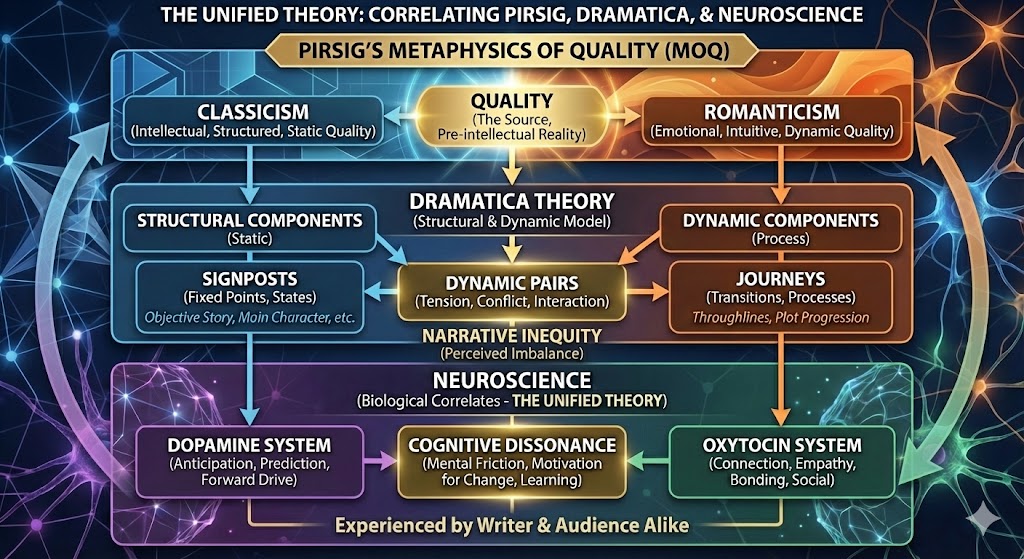
As for the theory, Zen and the Art of Motorcycle Maintenance identifies the meaning humans instinctively seek, Dramatica provides the structural engine to deliver it, and neuroscience measures the biological impact of that delivery on the audience.
Together, these three pillars form the Unified Theory of Narrative Engagement: a multidisciplinary framework modeling the interaction between narrative structure and human cognition.
Viewed through the lens of the Unified Theory, story becomes a predictive system. This framework allows creators to diagnose precisely where a narrative “leaks” engagement and provides a structural roadmap to repair those gaps and restore resonance.
Pirsig — What the Audience Is Seeking
Pirsig’s Metaphysics of Quality identifies what the audience is subconsciously pursuing when they engage with a story: an encounter with Quality. This is the pre-structural reason story matters at all. It defines the value the mind is searching for before any plot, character, or structure is applied.
Dramatica — How That Pursuit Must Be Structured
Dramatica defines how to build the container that allows the audience to experience the pursuit of Quality in an organized, meaningful way. It is the architecture that channels Pirsig’s Romantic search into a Classical form that the mind can follow. This maps naturally onto Dramatica’s core principle that story is a model of problem-solving, because Quality is what makes a problem worth solving in the first place.
Neuroscience — Why the Audience Cannot Disengage
Neuroscience answers the question neither Pirsig nor Dramatica directly address: What is happening in the brain when this works? Or, in the case of analyzing Who’s Harry Crumb, what causes an audience to disengage?
There’s much, much more, like calculus formulas and case studies that mention The Room and David Lynch’s work. Part 11 discusses further applications of the theory, which go well beyond storytelling to anything that involves “engagement,” from organizations to cognitive-based therapies.
Part 12 provides two in-depth case studies from personal experience, applying the theory (and Dramatica!) to real-world work experiences. One demonstrates a healthy, high-performance organization, while the other shows the complete opposite.
In my years of working in the first environment, I had thought Pirsig’s Zen and the Art of Motorcycle Maintenance might make for an interesting management “tool.” I just didn’t know how. In the second example, I left the place feeling like Red at the end of The Shawshank Redemption, knowing I would write about my experiences, but not yet understanding how. The Unified Theory killed two birds with one stone.
In closing:
Quality is the goal.
Dramatica is the map.
Neuroscience is the terrain.
This is the Unified Theory of Narrative Engagement: not an addition to Dramatica, but a model explaining why Dramatica aligns so precisely with how humans experience story, proving Chris and Melanie are truly visionaries.