Working on getting this into Dramatica and wasn’t sure if it was a Success or Failure story.
As a test, I asked Narrova if the Problem in the marriage was Effect or Expectation as the former would make the story an objective Success and the latter a Failure.
This response is so enlightening:
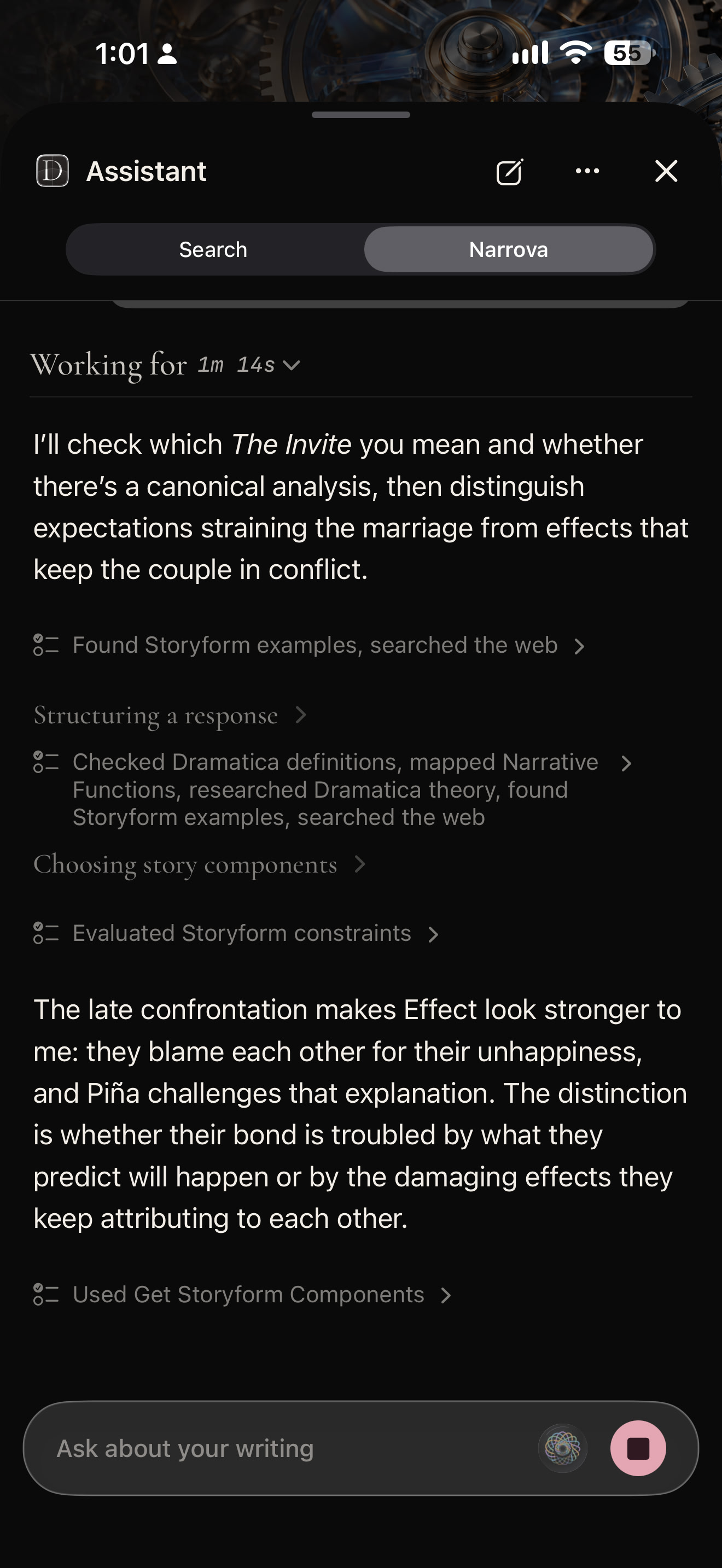
Here’s the full answer:
I lean toward Effect for Joe and Angela’s marriage—but provisionally. I’m working from published accounts of The Invite, not a direct viewing, and I found no canonical analysis. No Storyform Context is attached here.
The useful distinction is anticipated effects versus the effects they’re already having on each other. Dramatica’s Expectation concerns projecting what a particular cause will produce; Effect concerns the actual outcome, potentially becoming so absorbed in it that the underlying cause goes unaddressed. Expectation pairs with Determination; Effect pairs with Cause. These are two different structural arguments, not opposite ends of one pair. (dramatica.com)
Why Effect looks stronger: their marriage appears caught in a mutually damaging feedback loop. Affectionate exchanges have become brittle; Joe’s disappointment and Angela’s frustration permeate their interactions. The neighbors’ sexual intimacy makes their own estrangement more conspicuous. My reading is that the bond keeps suffering from what being together now does to them, rather than primarily from predictions about what it will do. (bfi.org.uk)
The strongest evidence is the late confrontation: they blame each other for their misery, and Piña challenges them to recognize unhappiness rooted in their own choices. That makes Effect → Cause worth investigating: stop fighting over the unhappiness each experiences and address what actually generates their destructive relationship. Piña’s explanation is evidence to test against the film—not automatically the author’s verdict. (tollbit.forbes.com)
Expectation would be stronger if their recurring trouble comes from anticipated payoffs: this encounter will revive us; this change in you will make us happy. Angela’s investment in the dinner and the contrast with their neighbors could support that reading, but wanting their intimacy doesn’t by itself establish Expectation as the Relationship Story Problem. (apnews.com) For comparison, the canonical Annie Hall analysis does identify Expectation as its Relationship Story Problem; a troubled romance alone doesn’t distinguish the two. (dramatica.com)
The deciding evidence is the piano ending: does their renewed tenderness follow from releasing a forecast of what marriage must deliver, or from interrupting how they’ve been hurting each other? The documented action allows either interpretation; I’d currently investigate the second—Effect—first. (tollbit.forbes.com)
—-
Success it is.
The difference between Expectation and Effect in Dramatica is so subtle. The definitions are very close together.
Nice to have a super intelligence to help square things away.