Want Narrova to read your script like a seasoned Dramatica analyst? Here’s a quick, repeatable workflow you can use right now—plus what to expect from the Storyforming Agent once it takes over.
TL;DR
-
Upload your PDF in Narrova.
-
Paste this prompt (or your variation of it):
review the uploaded screenplay and evaluate it across a Dramatica storyform, identify Four Throughlines (if they exist) and potential Storyforms for it
-
Narrova hands off to the Storyforming Agent (fine-tuned for Dramatica analysis).
-
You’ll get: a one-paragraph summary, the Four Throughlines with evidence, and—if warranted—one or more viable Storyform candidates with tables (Domain → Concern → Issue/Counterpoint → Problem/Solution).
-
If Narrova proposes two close Storyforms, choose the one that matches your intent or ask Narrova to help reconcile conflicts into a single, thematically consistent Storyform.
Why this works
Dramatica models a complete story as a single Storymind seen from four distinct perspectives (the Four Throughlines):
- Objective Story (OS) – the objective, everyone-in-the-problem view
- Main Character (MC) – the “me” point of view
- Influence Character (IC) – the “you” pressure that challenges the MC
- Relationship Story (RS) – the “we” between MC and IC
Each Throughline sits in a Domain (Universe / Physics / Mind / Psychology), drills down to a Concern, explores an Issue/Counterpoint, and resolves a Problem/Solution dynamic. A Storyform selects one consistent path through these choices (out of 32K+ possibilities) to capture the Author’s intent.
Reading a finished script is therefore both analysis and inference: we study the storytelling on the page to infer the subtext underneath—what the Author likely intended to say.
The workflow (with the “Brick” example)
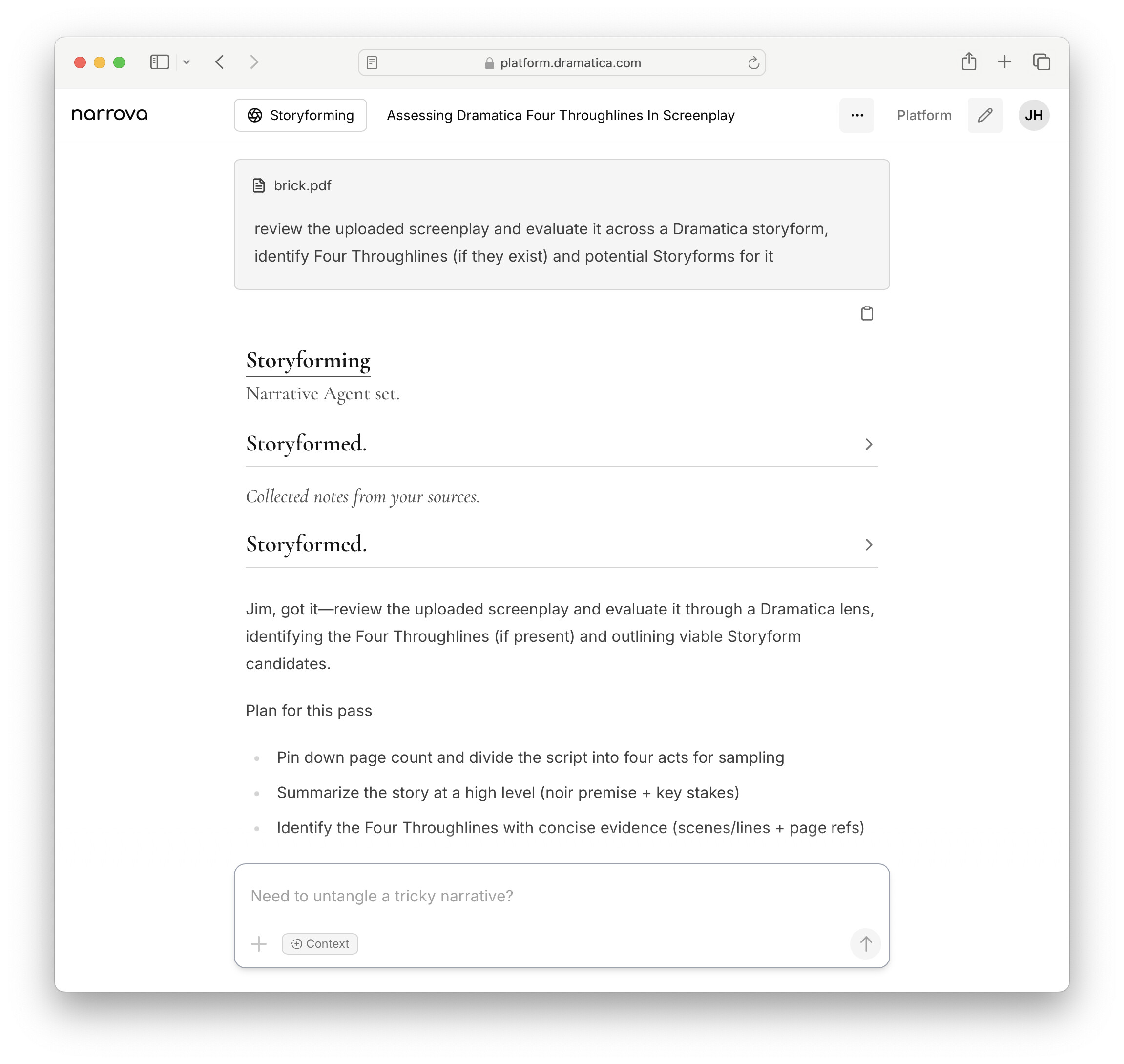
-
Upload your script PDF.
-
Paste the prompt above.
-
Narrova automatically routes to the Storyforming Agent, which outlines a plan:
- Pin down page count; sample across four acts.
- Write a tight, one-paragraph story summary.
- Identify Four Throughlines and cite scenes/lines/page refs as evidence.
-
Review the output:
- A summary that frames the spine of conflict.
- A bulleted evidence section for each Throughline (quotes, pages, scene beats).
- If signals are mixed, the agent will present alternate Storyform candidates.
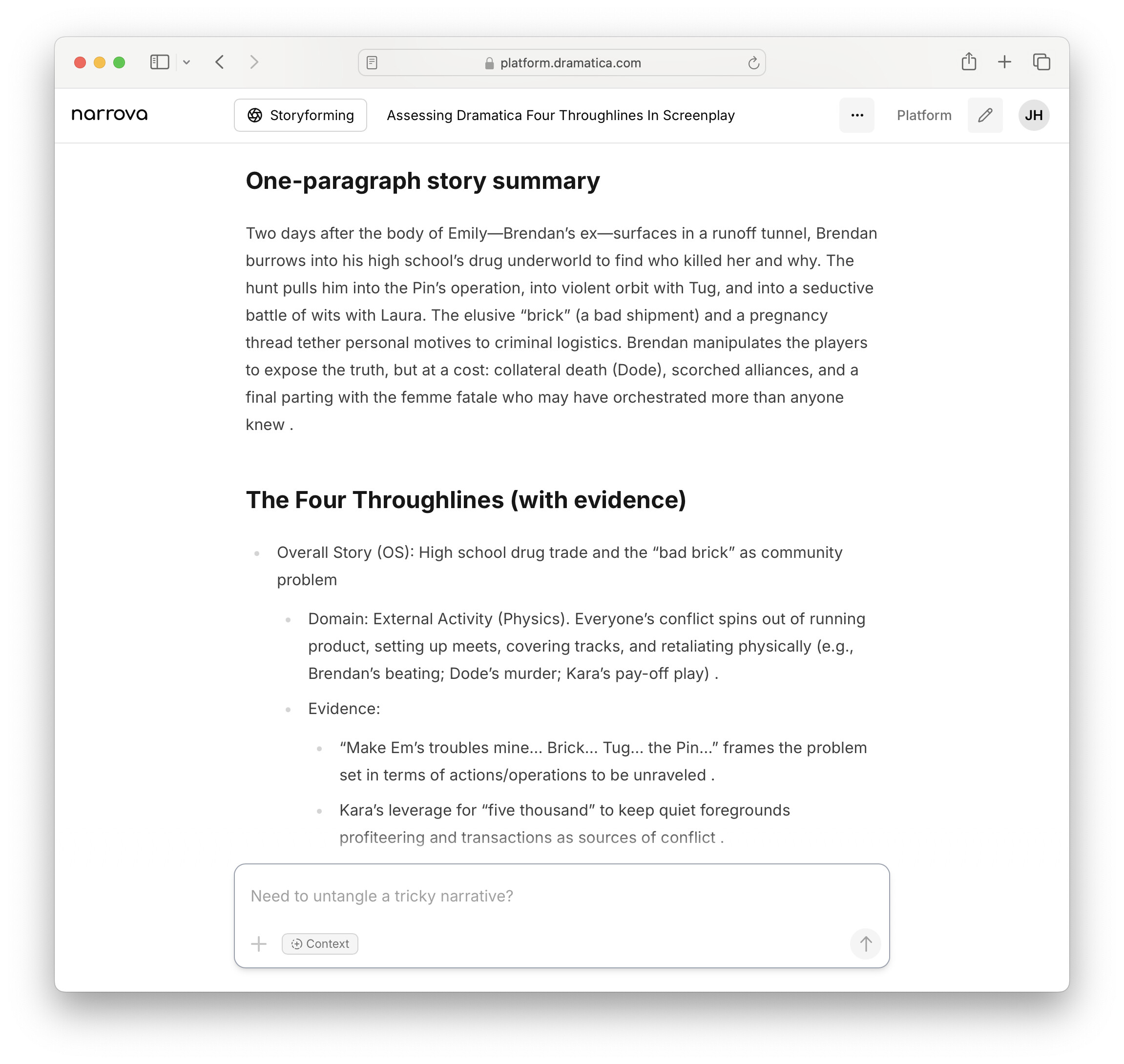
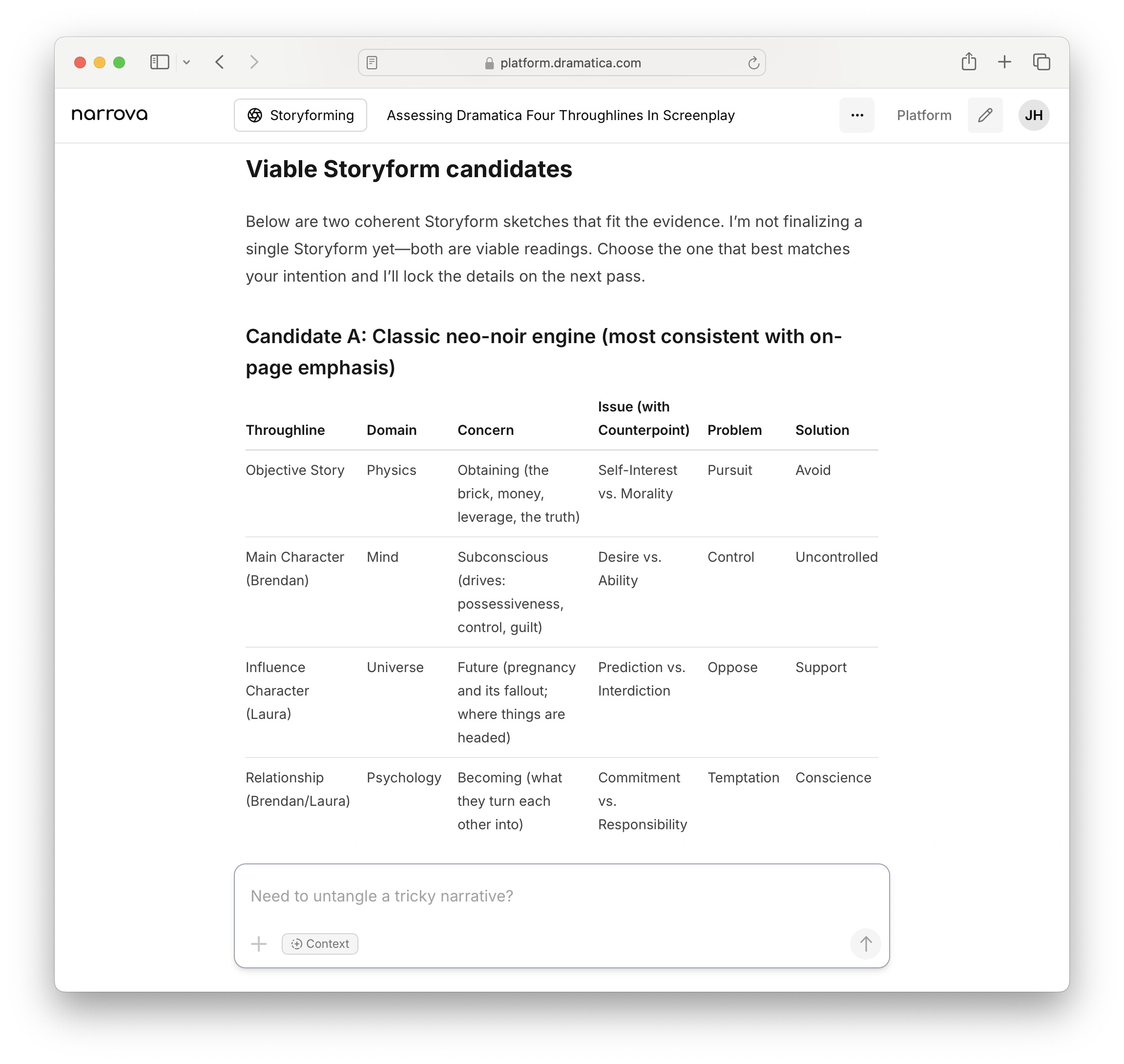
What a candidate table looks like (abridged example)
Candidate A (classic neo-noir read)
| Throughline | Domain | Concern | Issue (↔) | Problem | Solution |
|---|---|---|---|---|---|
| OS | Physics | Obtaining | Self-Interest ↔ Morality | Pursuit | Avoid |
| MC (Brendan) | Mind | Subconscious | Desire ↔ Ability | Control | Uncontrolled |
| IC (Laura) | Universe | Future | Prediction ↔ Interdiction | Oppose | Support |
| RS (Brendan/Laura) | Psychology | Becoming | Commitment ↔ Responsibility | Temptation | Conscience |
Candidate B** (more procedural/cognition read)
| Throughline | Domain | Concern | Issue (↔) | Problem | Solution |
|---|---|---|---|---|---|
| OS | Physics | Doing | Attitude ↔ Approach | Pursuit | Avoid |
| MC (Brendan) | Mind | Conscious | Appraisal ↔ Reappraisal | Consider | Reconsider |
| IC (Laura) | Universe | Present | Security ↔ Threat | Help | Hinder |
| RS (Brendan/Laura) | Psychology | Conceiving | Expediency ↔ Need | Temptation | Conscience |
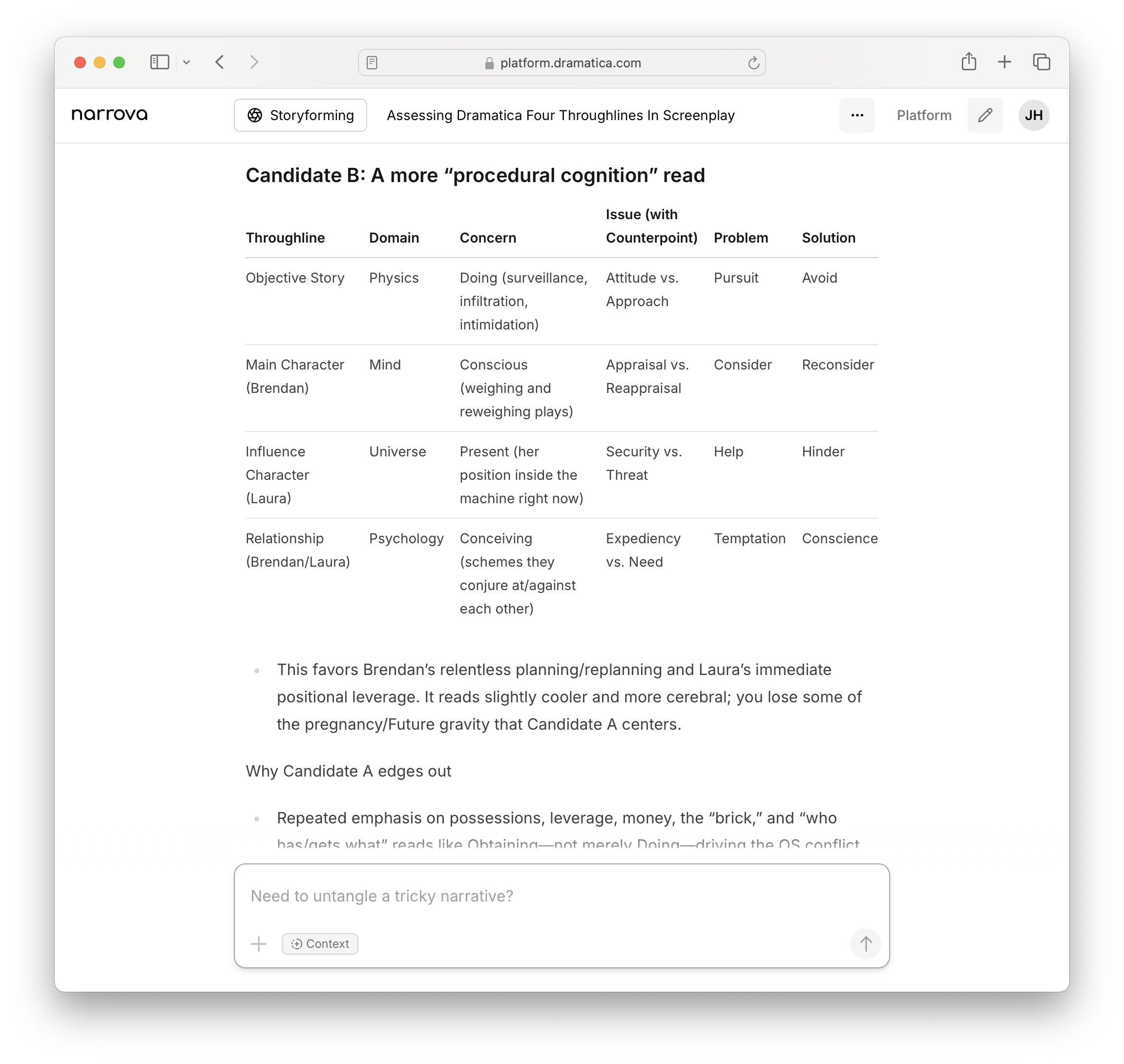
These are illustrative of what Narrova shows—your script will yield its own evidence and candidates.
“It found two Storyforms—now what?”
This is common when the text implies one pattern while your intent leans another. Two possibilities:
-
Both are close, but one better expresses what you meant.
- Ask: “Given my intent is X, which candidate aligns better? Show concrete page-referenced support.”
-
Signals conflict (e.g., OS feels like Obtaining, but much of the on-page action looks like Doing).
- Ask: “List the top 5 inconsistencies preventing a single Storyform and propose targeted scene fixes.”
Important: Sharp-eyed Dramatica users may notice that even “close” candidates can contain theme-level contradictions (i.e., not a viable Storyform). Narrova explicitly balances what’s on the page with the Author’s aim. If you want to tighten to a strict Dramatica Storyform, say so and Narrova will prioritize internal consistency over what’s merely implied.