I tried a workflow this morning that felt worth sharing because it moved cleanly from Dramatica structure into something much more tangible: a visual ensemble for a story.
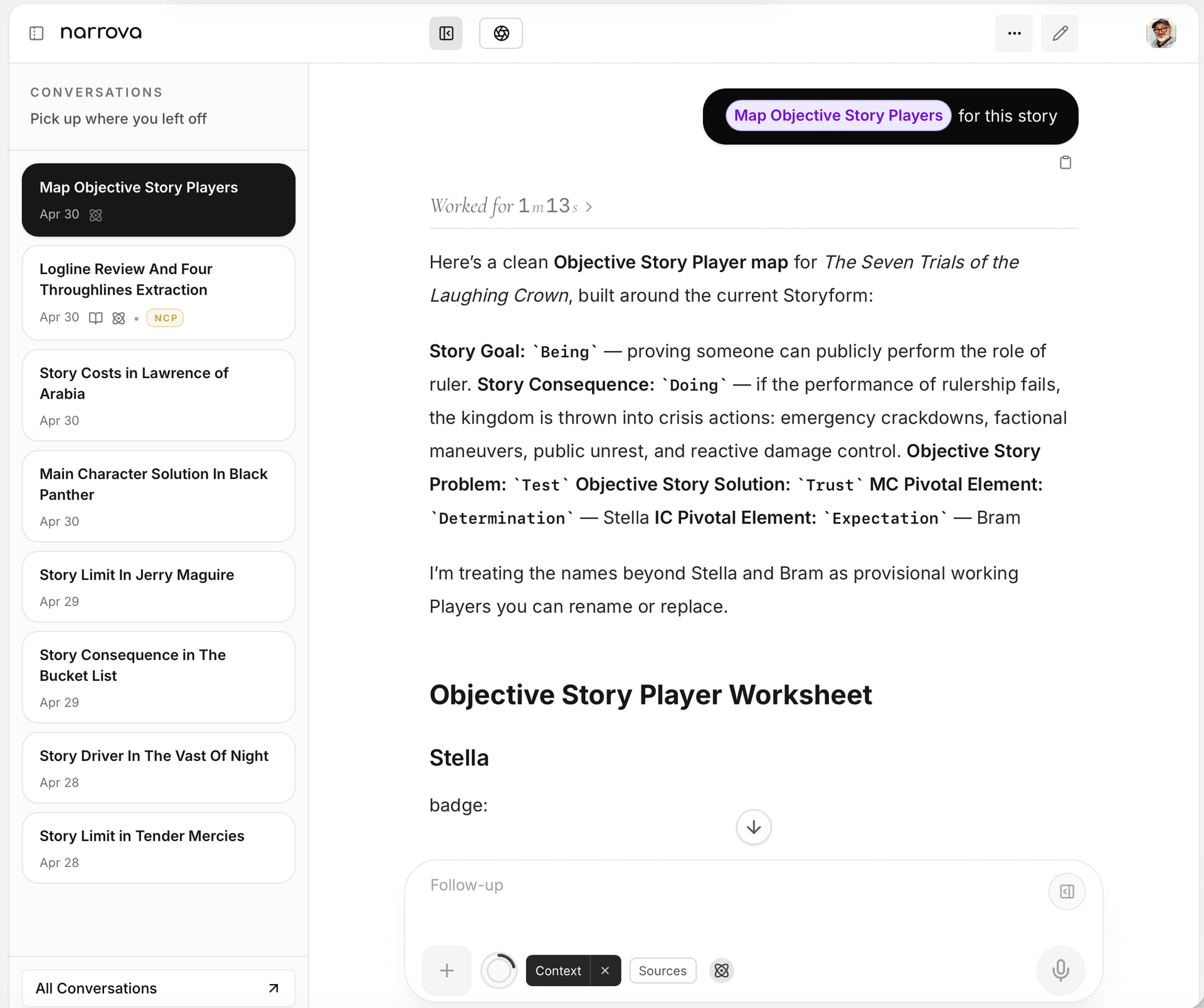
The story was The Seven Trials of the Laughing Crown, a hand-drawn animated feature idea built around a royal succession crisis. Before asking for artwork, I had Narrova map the Objective Story Players from the Storyform so the cast image would not just be a collection of character vibes. The goal was to make sure each player had a clear Objective Story function before turning them into a promo banner.
Here is the basic structural setup Narrova used:
- Story Goal: Being - proving someone can publicly perform the role of ruler.
- Story Consequence: Doing - if the performance of rulership fails, the kingdom falls into crisis actions: emergency crackdowns, factional maneuvers, public unrest, and reactive damage control.
- Objective Story Problem: Test
- Objective Story Solution: Trust
- Main Character Pivotal Element: Determination, carried by Stella
- Influence Character Pivotal Element: Expectation, carried by Bram
The useful part was that the Player map stayed Objective Story-facing. Stella was not framed around how she feels about being overlooked; she was framed around what everyone can see her doing in the story: identifying the real cause behind each trial failure, pushing the succession forward, organizing the chaos, and helping keep ceremonies from turning into disasters.
Bram, by contrast, carried Expectation. His function was to make the crown’s image depend on performance, charm, and what people expect royalty to look like, even when that expectation threatens the actual succession effort.
Narrova then spread the rest of the cast across the Objective Story machinery:
- Queen Aurelia carried Trust, Support, Conscience, and Faith as the aging sovereign preserving continuity.
- Lord Voss carried Avoid, Oppose, Hinder, and Reconsider as the organized resistance to the Story Goal.
- The Seven Trialmasters carried Test, Proaction, Probability, and Acceptance as the institutional pressure forcing every claim of rulership through public ordeal.
- Chancellor Merek carried Proven, Accurate, Deduction, and Evaluation as the procedural administrator of legitimacy.
- Lady Peony Vale carried Unproven, Non-accurate, Induction, and Re-evaluation as the public image and rumor machine.
- Captain Rowe carried Control, Protection, Inaction, and Certainty as the security force trying to contain risk.
What I liked about this was the way the map prevented the trials from becoming the same beat over and over: Bram fails, Stella fixes it. Instead, each Player gives the seven trials a different kind of pressure: political resistance, public expectation, institutional testing, legal proof, rumor, security, and finally the need to Trust before certainty is possible.
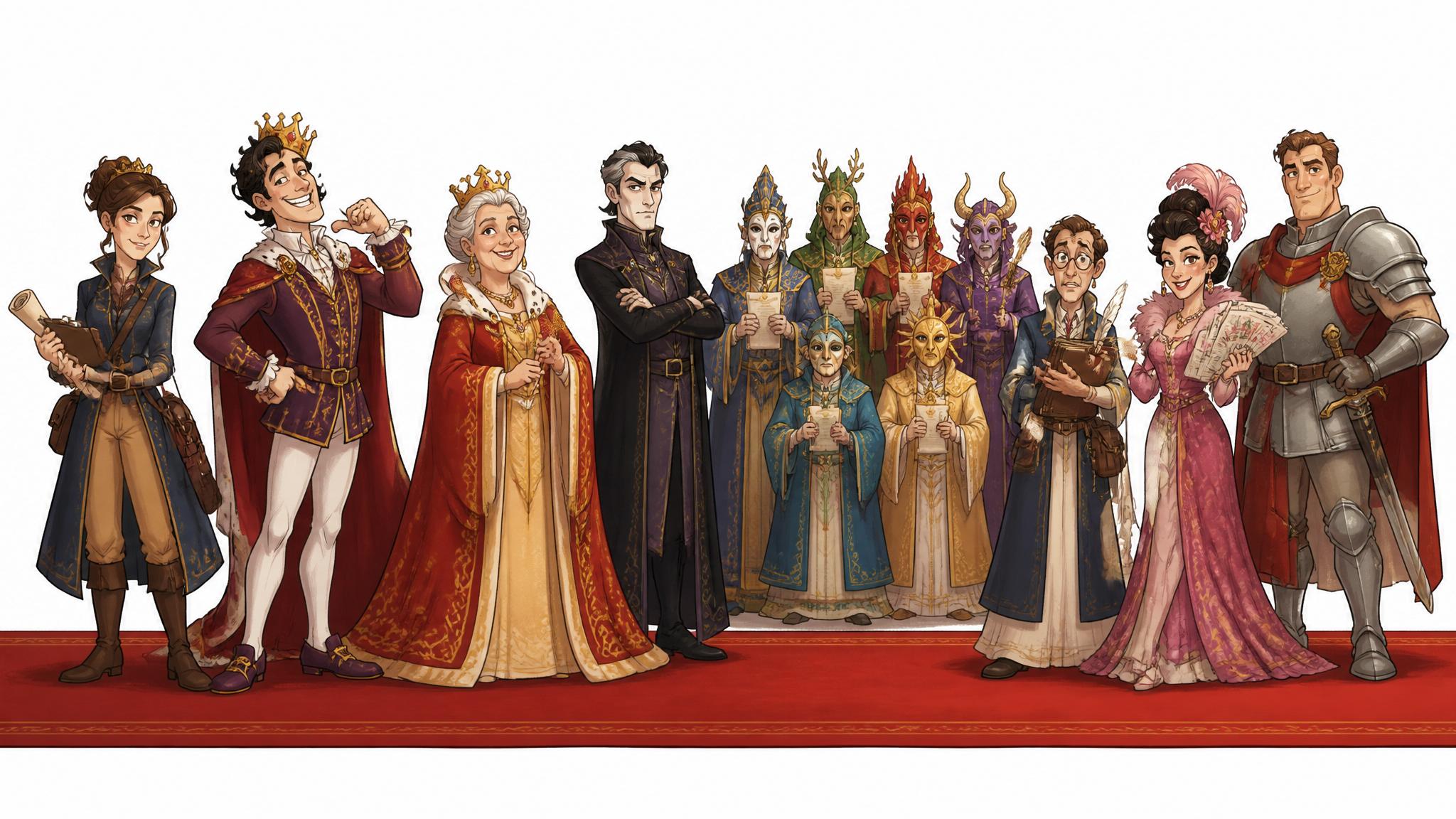
After that, I asked Narrova to generate a 16:9 promo banner with all of those Players standing together on a royal red carpet against a white background. The first set of characters was an impressive technological achievement, but the designs themselves were horrendous. I have always been a fan of UPA-style character design, so I asked for a second pass in more of that 1960s graphic style with each character’s name underneath.
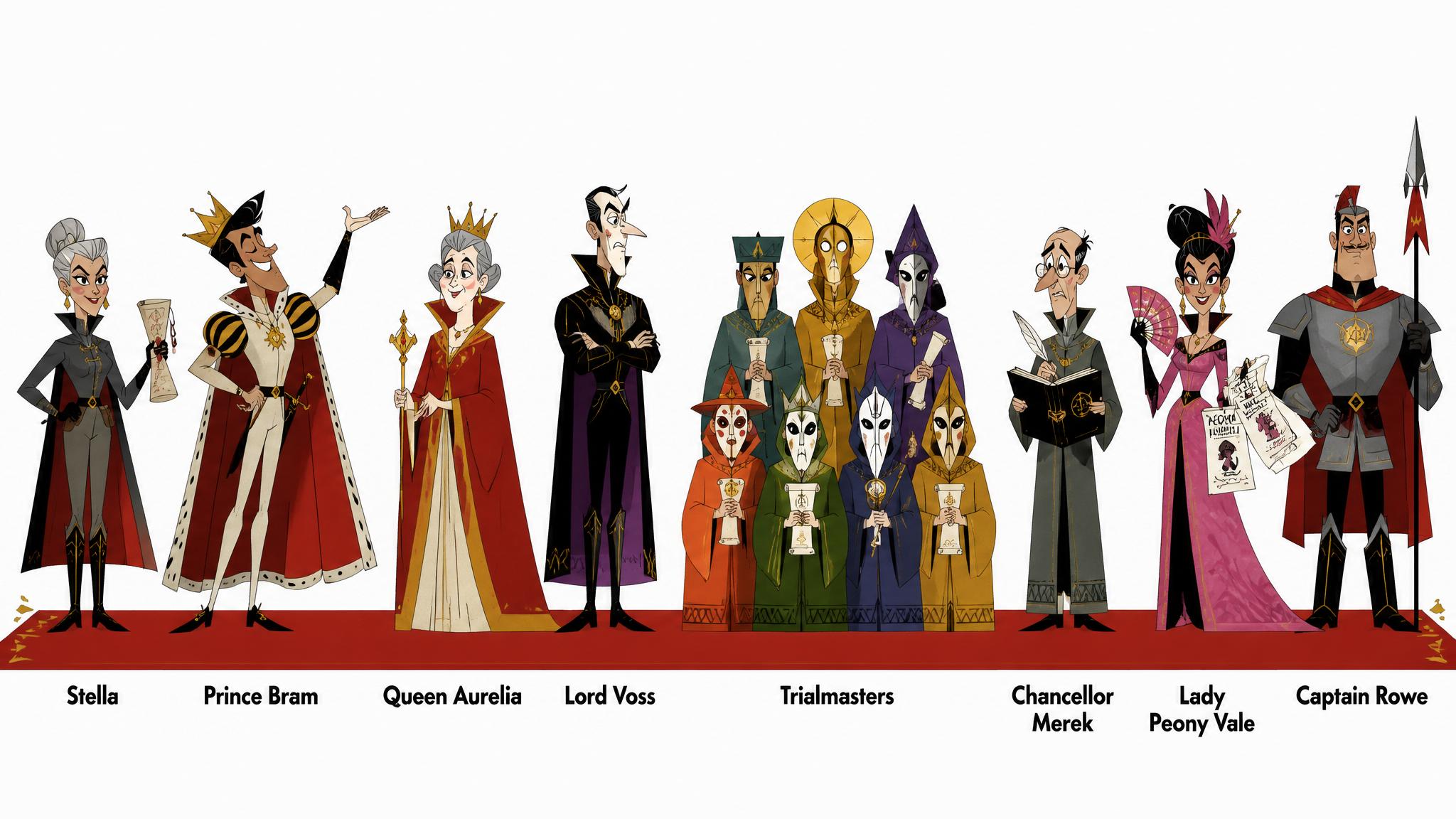
The result was a nice reminder that the Player map is not just an analytical artifact. Once the Objective Story functions are clear, they can become a practical creative brief: costume, posture, relative prominence, attitude, and ensemble shape all have something structural to work from.
Curious if anyone else is using Objective Story Player mapping this way before generating visuals, pitch materials, or character sheets.